Listing Date and Type of Listing
The Hine’s emerald dragonfly was added to the US List of Endangered and Threatened Wildlife and Plants on January 26, 1995. It is illegal to harm, harass, collect, or kill the dragonfly without a permit from the U.S. Fish and Wildlife Service. This dragonfly is the only dragonfly of the 52 insects on the US Endangered List.
Research has been done on the remaining populations of the Hine’s emerald and the results are grim. It has been found that many of these populations live in small groups and are therefore simple to wipe out with a single instance of heavy pollution from human influences.
Cause of Listing and Main Threats
1. Habitat Loss or Degradation
By far the greatest threat, habitat degradation has plagued the once thriving populations of these creatures. Most of their wetland habitat that this dragonfly depends on has been drained and filled to make way for urban and industrial development.
2. Pesticides and Other Pollutants
Contamination of wetlands by pesticides or other pollutants also poses a threat. The dragonfly depends on pristine wetland or stream areas, with good water quality, for growth and development.
3. Changes in Ground Water
Development that decreases the amount or quality of ground water flowing to the dragonfly’s habitat threatens its survival because it depends on spring-fed shallow water to breed.
Description of Recovery Plan
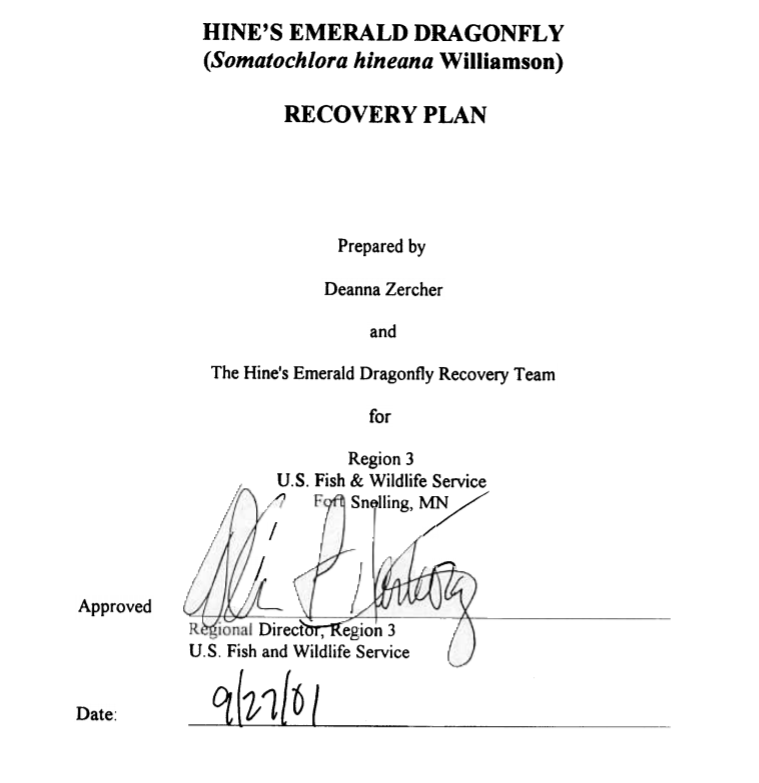
The U.S. Fish and Wildlife Service prepared a recovery plan that describes and prioritizes actions needed to help the dragonfly survive. This plan went into effect on September 27, 2001.
The plan breaks down into 6 main actions that plan to be taken:
- Protect and manage extant populations
- This includes developing strategies to promote recovery, setting up long-term watershed habitat protection, annual monitoring of the population, and habitat management in all 4 states where the Hine’s emerald is present.
- Conduct studies
- This includes studies on the ecology of the dragonfly through all stages of its life, studies on the best ways to monitor population, habitat management, water quality monitoring, and effects of environmental contaminants.
- Conduct searches for additional Hine’s emerald populations
- This includes searching for larval habitats withing existing sites, and for additional populations in states where the Hine’s emerald originated, in states where they are located currently, and other states where it could be located.
- Conduct a reintroduction and augmentation program
- This includes developing captive rearing protocols, assess sites for reintroduction, introduction, or augmentation, and monitoring these annually.
- Conduct an information and education program
- This includes encouraging private landowners to conserve this dragonfly, informing local and county governments of recovery goals, and developing outreach material on life history and conservation.
- Review and track recovery progress
- This includes maintaining a clearinghouse for Hine’s emerald information, conducting recovery team meetings to evaluate progress, revise plan at 5 year intervals.
The total estimated cost of this program is $13,163,000. At the time of this plan’s implementation, they predicted full recovery as early as 10 years after these 6 recovery criteria have been met.
 Hine's Emerald Dragonfly