Description
The Hine’s emerald dragonfly (Somatochlora hineana) was discovered in Ohio, Indiana, and Alabama. However, its population has been extirpated from those states and today can only be found in Illinois, Michigan, Missouri and Wisconsin. The dragonfly lives in spring-fed marshes that are usually high in calcium carbonate, which makes their exoskeleton stronger. They can also be found in sedge meadows and are generally around slowly flowing water and nearby forest edges.
The Hine’s emerald dragonfly has bright emerald-green eyes with a metallic green body, vibrant yellow stripes along the side of its torso. Its average size is about 2.5 inches long with a wingspan of about 3.3 inches.
The male dragonflies protect their own breeding territories, mating with females that come to reproduce. The female lays eggs in the water and nymphs, or baby dragonflies, hatch from the eggs. The nymph lives in the water for 2-4 years, and then eventually crawls out of the water, shedding its skin, and emerging as a flying adult. This life is much shorter than their previous form however, often only living 4-5 more weeks.
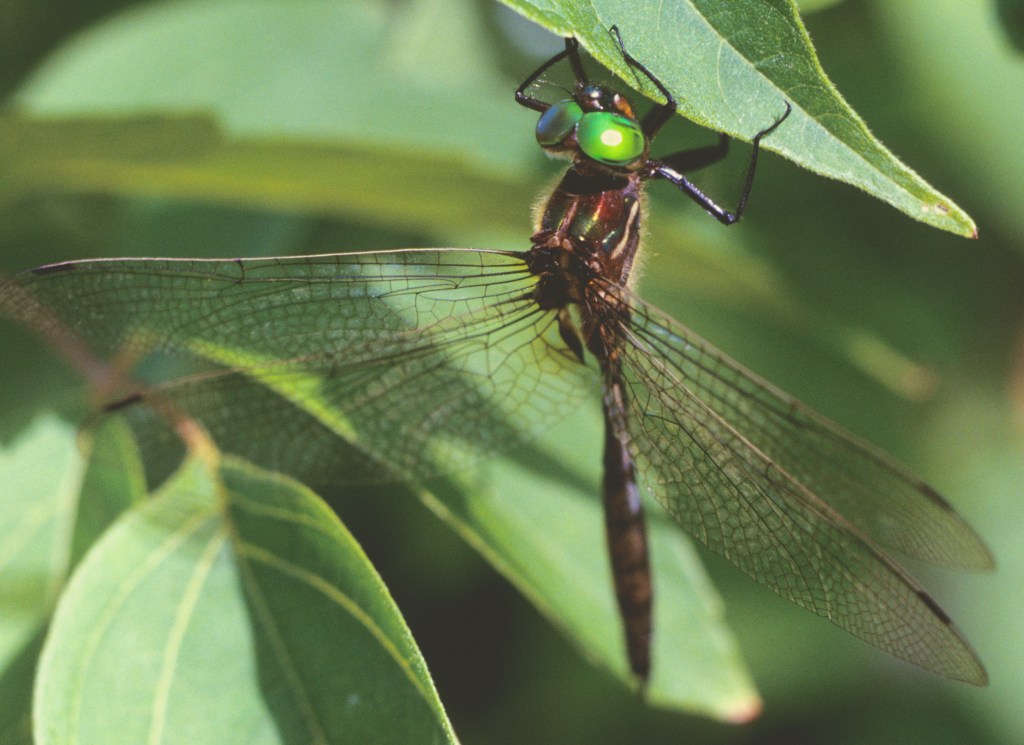
Dragonflies play an important role in nature. They catch and eat small flying insects, including mosquitoes, biting flies, and gnats. While they prey on pests like these, they are an important prey to aquatic animals like fish while the dragonflies are in their nymph stage.
Geographic and Population Changes
The Hine’s emerald dragonfly was discovered in Ohio, Indiana, and Alabama. However, its population has been extirpated from those states and today can only be found in Illinois, Michigan, Missouri and Wisconsin. The dragonfly lives in spring-fed marshes that are usually high in calcium carbonate, which makes their exoskeleton stronger. They can also be found in sedge meadows and are generally around slowly flowing water and nearby forest edges.
The Hine’s emerald dragonfly is extremely susceptible to changes in the water flow. With decreases in water flow or pollution in water flow, this dragonfly decreases in population. This is because the dragonfly depends on the clean flowing water to survive and breed its offspring. Recently, pesticides and other pollutants entering the water flow have been large factors in shallow streams of water in wiping out the localized populations of Hine’s dragonflies. One major contributor to this is golf courses, who drastically change bodies of water, sometimes removing them entirely.
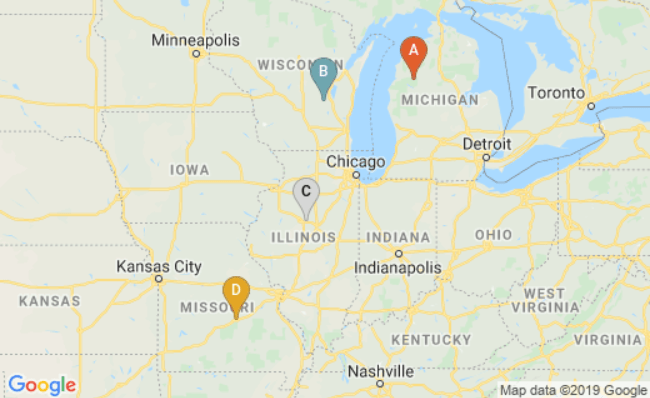
 Hine's Emerald Dragonfly